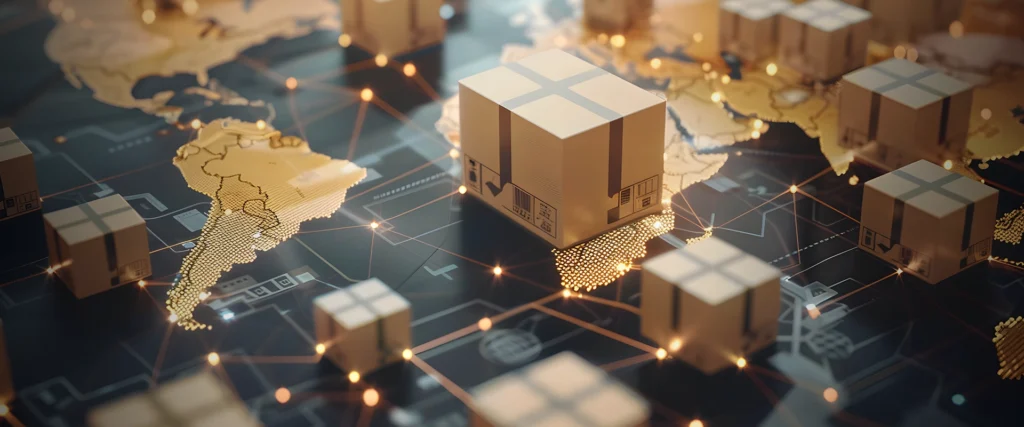




Route plans fail in predictable ways. A truck gets stuck in unexpected traffic. A driver takes longer at a stop than estimated. A client requests an urgent delivery mid-route. Weather closes a highway. Traditional routing systems handle these failures the same way: a dispatcher manually intervenes and patches the plan.
AI route optimization treats volatility as the baseline operating condition. It monitors traffic feeds, weather data, vehicle locations and new orders continuously. When conditions diverge from the plan, the system recalculates routes automatically. No manual intervention required for routine disruptions. Dispatchers handle genuine exceptions, not predictable volatility.
What is AI route optimization?
AI route optimization calculates routes by processing traffic data, weather forecasts, driver behavior, vehicle fuel efficiency, delivery windows and constraints such as one-way streets or loading dock hours. Traditional systems work from fixed rules: the shortest distance gets the route. AI evaluates millions of variables simultaneously.
AI uses probabilistic methods to find near-optimal solutions in seconds:
- Genetic algorithms (evolve better routes through “breeding”)
- Reinforcement learning (learn through trial and error)
- Neural networks (recognize patterns humans can’t see)
Can AI do route planning? Yes, and it does so by learning from patterns, adapting to real-time conditions and improving without human reconfiguration.
Read also: Delivery management software solutions
Why it is important?
Logistics companies operate on narrow margins. Cost per mile determines profitability.
How can AI route optimization reduce delivery costs and improve efficiency? Here are three mechanisms:
- Fuel savings: Fuel represents about 24% of fleet operating costs. AI reduces consumption significantly by minimizing distance and optimizing for factors traditional routing ignores: elevation changes, stop-and-go traffic, idling duration, vehicle-specific efficiency curves. A route that looks longer on paper often burns less fuel by avoiding congestion or eliminating left turns that require idling at traffic lights.
- Asset utilization: Traditional dispatchers can’t coordinate empty return trips with new pickup requests in real time, the mental load is too high. AI processes these opportunities automatically, reducing deadhead miles (industry jargon for driving without cargo).
- Labor efficiency: Route planning that took a dispatch team two hours now takes three minutes. Dispatchers switch from calculation to exception management: the high-value work of handling unusual situations that require human judgment. A truck breaks down, a customer reschedules, a road closes – these are the problems worth human attention.
Key capabilities
AI route optimization differs from traditional routing software in three ways. Traditional systems assume stable conditions, handle limited constraint sets and require manual updates to improve. AI systems adapt to changing conditions in real time, evaluate dozens of constraints simultaneously and learn from operational data without reprogramming.
Courier management software that incorporates these capabilities handles volatility that would break legacy systems.
Real-time adaptation
How does AI help in real-time traffic and weather prediction for route planning? Traditional routing treats the road network as static. AI route optimization integrates live data streams:
- Traffic APIs (updated every 30 seconds)
- Weather radar
- Construction databases
- Event schedules
- Social media feeds (detecting unexpected congestion)
Machine learning models analyze historical traffic patterns and predict that a specific highway segment will congest in 45 minutes. The system reroutes trucks before the congestion materializes, avoiding delays that haven’t happened yet.
This prediction capability, combined with event-driven architecture, means the system recalculates routes whenever conditions change: new orders, traffic updates, vehicle breakdowns. Traditional systems wait for the next scheduled planning cycle. AI reacts in milliseconds.
Read also: Pickup and delivery management software
Constraint handling
Real-world routing involves dozens of constraints:
- Delivery time windows
- Vehicle capacity limits
- Driver skill certifications
- Customer access restrictions
- Regulatory hours-of-service limits
- Vehicle-specific road restrictions
AI encodes each constraint mathematically. Consider a route that minimizes total distance: it might require a driver to work past regulatory limits or arrive at a customer site outside their receiving hours. The system evaluates every potential route against all constraints at once, not sequentially.
Conflicting constraints are inevitable. Delivery windows overlap with driver break requirements. Shortest routes conflict with vehicle weight restrictions. When this happens, business rules determine which constraint wins. The typical hierarchy: customer commitments first, regulatory compliance second, fuel efficiency third.
Continuous learning
AI route optimization improves through feedback loops. When actual drive times diverge from predictions, the system updates its models; it learns which customers frequently request rescheduling, which intersections consistently cause delays, which drivers perform better on certain route types.
This happens automatically, without manual retraining. Integration of fleet optimization with electronic proof of delivery systems provides the data that makes these feedback loops possible.
Use cases
The optimization targets vary by industry. Last-mile delivery companies maximize stops per route to reduce cost per delivery. Field service organizations match technician qualifications to job requirements while keeping travel time low. Electric fleet operators balance range limitations against charging infrastructure availability. Maritime operators minimize fuel consumption while avoiding conflict zones and severe weather.
Last-mile delivery
How does AI optimize last-mile delivery routes? Last-mile represents 53% of total shipping costs. Urban environments multiply complexity: one-way streets, parking restrictions, building access codes, narrow delivery windows.
AI navigates these using geocoding precision: mapping addresses to specific building entrances, not zip codes. Real-time parking availability prevents trucks from circling blocks.
Field service management
Field service adds a layer: technicians aren’t interchangeable. AI matches technicians to jobs based on qualifications while optimizing routes:
- Medical device certification → hospital calls
- HVAC specialist → heating emergencies
- High-voltage license → industrial sites
Electric vehicle fleets
EVs introduce the energy vehicle routing problem (EVRP). Battery charge becomes a dynamic constraint.
Variables affecting range:
- Cold weather (40-59% reduction)
- Hills (drain batteries on ascent)
- Temperature affects battery chemistry
AI incorporates discharge models, terrain data and temperature forecasts. It plans charging stops aligned with driver breaks and staggers fleet charging to avoid depot power overloads. For companies transitioning to electric, this determines viability. The difference between “we can’t serve that customer” and “route planned with charging at mile 87.”
Cross-border and maritime
What industries can benefit the most from AI-based route optimization? Any operation where vehicles or people move between multiple stops. Maritime shipping shows how AI handles unique constraints:
- Weather routing: Analyze currents and storms for efficient paths. “Slow steaming” strategies balance speed against fuel consumption.
- Geopolitical risk: Monitor conflict zones and piracy in real time. Red Sea disruptions? Reroute around Cape of Good Hope.
- Port optimization: Predict congestion. Advise vessels to adjust speed. Arrive when berths are available, not hours early burning fuel at anchorage.
Implementation centers on build versus buy versus hybrid. Each path carries different trade-offs.
The three paths:
- Off-the-shelf: Fast deployment
- Custom build: Full control
- Hybrid: Commercial APIs + custom layers
Off-the-shelf solutions
SaaS platforms offer fastest deployment: 2-4 weeks from contract to production. They work well when standard workflows fit your operation and you need to prove value quickly. Providers like Descartes and NextBillion.ai deliver enterprise-grade solvers with standardized features.
The constraint is customization. These systems handle common use cases well but struggle with unusual business rules or complex legacy integrations.
Custom development
What technologies are commonly used? The technical stack includes optimization libraries like OR-Tools and OptaPlanner, ML frameworks like TensorFlow and PyTorch, graph databases like Neo4j for network modeling and real-time processing through Apache Kafka. Machine learning powers traffic forecasting, demand prediction, ETA estimation and the continuous improvement loops.
Custom builds make sense when routing creates competitive advantage or when unique business requirements demand tailored solutions. The trade-offs: higher cost, longer timeline (3-6 months), but precise alignment with requirements.
Hybrid approach
The emerging pattern: commercial APIs for core optimization plus custom layers for everything else.
Companies use APIs for the heavy computational work: enterprise algorithms without research investment. The custom work goes into data integration, business rules, user interfaces and legacy system connections. This delivers enterprise-grade algorithms without reinventing mathematics while maintaining control over differentiating features. Faster than full custom build. More flexible than pure SaaS.
Implementation requires infrastructure work that people often underestimate. Address geocoding must map to building entrances, not zip codes. Vehicle telemetry needs real-time pipelines. Historical data requires cleaning before training. Integration with ERPs, warehouse management and order systems determines whether the AI operates in isolation or becomes part of operations. The best algorithms fail on bad data.

About the authorSoftware Mind
Software Mind provides companies with autonomous development teams who manage software life cycles from ideation to release and beyond. For over 25 years we’ve been enriching organizations with the talent they need to boost scalability, drive dynamic growth and bring disruptive ideas to life. Our top-notch engineering teams combine ownership with leading technologies, including cloud, AI, data science and embedded software to accelerate digital transformations and boost software delivery. A culture that embraces openness, craves more and acts with respect enables our bold and passionate people to create evolutive solutions that support scale-ups, unicorns and enterprise-level companies around the world.