

Embedded Software Services
Accelerate your digital transformation with embedded software services that deliver custom hardware development, testing, verification and consulting support.
Drive your digital transformation with embedded services
Software Mind’s highly skilled embedded team supports individual stages of embedded systems development as well as complex projects. Our cross-functional teams maximize value by configuring hardware platforms and developing embedded applications, as well as verifying, testing and maintaining firmware.
Embedded services and consultancy that deliver innovation
Design embedded systems software architecture
Turn to an experienced embedded software design team that empowers organizations with real-world knowledge of the latest technologies and modern platforms for embedded software development. Our experts design firmware, develop testing tools and environments, deliver functional applications and incorporate third-party modules.

Develop firmware for devices
Focus on your business while our team assists with every step of your device creation process – from architecture design and firmware development to troubleshooting, documentation and maintenance support. Our embedded experts develop firmware for MCUs, engineer drivers, platforms, applications and operating systems, implement wired and wireless communication standards and upgrade testing and firmware capabilities.

Configure, test and verify systems
Take advantage of complete firmware life cycle management, embedded systems configuration and testing. Our embedded software experts’ deep knowledge of communication standards enables them to provide tailor-made embedded systems support to ensure products are secure, high-quality and bug-free. Beyond ensuring quality assurance, our team automates tests, performs conformance testing and audits security measures.
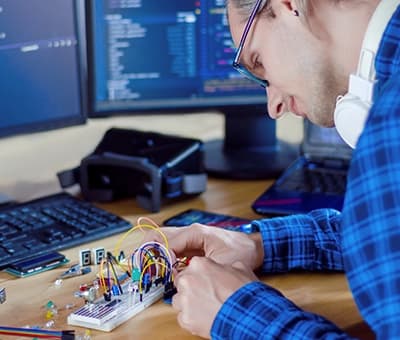
Explore data and AI best practices for manufacturing
Get insights about the strategies and tech manufacturers can use to begin targeted AI implementation. Check out real-world use cases about QA automation and scrap rate reduction.

Embedded AI services

Customize AI and embedded development
Partner with a team of experienced data engineers to create tailored development of machine learning (ML) models designed to meet the unique requirements of your embedded applications.

Implement cost-effective embedded strategies
Conduct compatibility assessments to ensure optimal AI model integration with your specific hardware architecture.

Enable data-driven decision making
Design and implement algorithms for real-time decision-making within your embedded system that minimize latency in AI-driven processes.

Optimize resource-constrained environments
Overcome power consumption challenges and memory limitations by optimizing inference engines for edge computing to ensure high-performance of AI models on your embedded platforms.

Design and develop intelligent devices
Seamlessly integrate AI into your embedded systems to enhance the intelligence and decision-making capabilities of your devices.

AI-aided audio and visual solutions
Empower audio devices with AI and ML models for speech enhancement and secure audio and video content with advanced watermarking techniques.
Maximize embedded systems’ efficiency
Implement hardware acceleration and parallel processing techniques to maximize development.

Improve your production efficiency and quality
Leverage existing test and telemetry data for smart, industrial-grade solutions and real-time predictive maintenance.
Real-time operating systems (RTOS) experience and innovation that deliver results
01
Development
Development
Create real-time applications, including device drivers, communication protocols and low-level software components with cross-functional embedded engineers who can also help select the appropriate RTOS for your specific application and hardware architecture.
03
Porting and migration
Porting and migration
Port existing software and applications to a different RTOS or migrate from a bare-metal system to a real-time platform with embedded specialists who have a proven record of ensuring seamless transition and optimization for the target RTOS environment.
05
Maintenance and support
Maintenance and support
Ensure the long-term reliability of your RTOS-based solutions by receiving ongoing support and maintenance services that cover updates, patches and troubleshooting. Turn to embedded security and safety compliance services that evaluate and implement security measures in RTOS-based systems and help achieve compliance with industry-specific safety standards.
02
Integration
Integration
Integrate your chosen RTOS into an embedded system that’s configured and optimized for performance. Customize existing RTOS kernels to deal with real-time constraints and deliver desired functionalities.
04
Testing services
Testing services
Get comprehensive testing of real-time applications that validates adherence to timing constraints and system requirements. Along with verifying RTOS configurations and optimizations for robust and reliable performance, our embedded teams analyze system performance to identify bottlenecks and areas for optimization – from task scheduling and resource management to overall system responsiveness.
01
Development
Development
Create real-time applications, including device drivers, communication protocols and low-level software components with cross-functional embedded engineers who can also help select the appropriate RTOS for your specific application and hardware architecture.
02
Integration
Integration
Integrate your chosen RTOS into an embedded system that’s configured and optimized for performance. Customize existing RTOS kernels to deal with real-time constraints and deliver desired functionalities.
Case studies


What our clients say
Proven embedded services support
Experience across sectors
A proven record of successfully implementing IoT and embedded software projects across industries ensures effective collaboration.
Full software development life cycle support
We are a one-stop shop for embedded software and systems design for developing, testing and maintaining solutions.
Scalable embedded teams
Experienced embedded specialists scale up or down according to your needs.
Talented experts
Our diverse talent pool covers cloud solutions, IoT, mobile and web app development, DevOps, cybersecurity and leading emerging technologies.
Flexibility and value-driven development
An open culture and domain knowledge mean swift onboarding, smooth cooperation and full understanding of business goals.
Effective ways of working
Agile and proactive approaches that prioritize ownership and transparency result in efficient problem solving, improvements and knowledge transfers.
Technologies
Our cross-functional teams work with best-of-breed tools to develop customized solutions that deliver rewarding experiences and comply with market regulations.
Operating systems
Platforms
Connectivity
Programming languages
Leaders we partner with

Software Mind is a proud member of the Bluetooth Special Interest Group (SIG). This membership signifies our commitment to staying at the forefront of Bluetooth technology developments, standards and innovations. As a Bluetooth SIG member, Software Mind engages in collaborative efforts that contribute to the advancement and adoption of Bluetooth technology across various applications and industries.
Being a trusted partner in the Toradex Partner Network and Torizon Partner Program enables Software Mind to showcase our expertise in embedded and edge AI technologies. By integrating Toradex’s advanced hardware with Torizon’s Linux platform, we can deliver scalable AI solutions for manufacturing and industrial applications that enhance efficiency and productivity in demanding environments.
Embedded software insights
Get expert advice and best practices on developing embedded systems, architectures and software.













Get embedded support, from software to firmware
1600
+ experts
25
+ years of innovation
350
+ clients who trust us
Embedded Software Services – FAQ
What is embedded software?
Embedded software is a piece of software that is implanted in hardware or non-PC devices. Written specifically for the particular hardware that it runs on, it usually has processing and memory restrictions because of the device’s limited computing capabilities. Embedded software is becoming more and more important throughout industries, and can be found in a range of solutions, including GPS devices used in the automotive sector, factory robots for various types of manufacturing tasks, calculators and even smartwatches.
What is RTOS and why it is important for embedded systems?
What is bare metal programming?
How will the EU’s Cyber Resilience Act (CRA) impact the development of embedded systems?
Why might porting embedded software to a different MCU be required?
What should embedded software developers know about the EU’s Data Act?
What is hardware-in-the-loop (HIL) testing?
How does HIL testing benefit the development of embedded systems?
What does embedded AI require from embedded systems?
Looking for other software services?
For over two decades we’ve been helping companies across markets and sectors develop disruptive solutions. Proven ways of working, domain knowledge and an open culture that prioritizes ownership mean we contribute from day one.
Engineering and consultancy that deliver value






Automation testing services
Build tailored testing platforms and boost test coverage for critical app areas.
Engineering expertise that supports industries


Financial services
Engineer customized solutions that increase personalization and user conversion across channels.