




Table of contents:
The gap between teams that use AI and teams that don’t isn’t growing. It’s splitting wide open. One side ships software in days. The other is still weeks or months out. And the usual fix (hire the talent, build the capability in-house) takes longer than the gap will wait.
AI can automate, accelerate and optimize workflows all day. What it hasn’t earned yet is trust. Almost nobody is ready to hand it the keys and walk away, and they shouldn’t be. That’s why human-led, AI-driven development sits at the top of board agendas in every industry. Here’s what that looks like in practice. And what it actually delivers.
Integrating AI SDLC – getting started
Here’s the wrong way to start: buy licenses, announce productivity gains, wait. Nothing happens. Meaningful, targeted AI integration means aiming at the places that actually hurt: requirements that fail, tests that are weak, reviews that stall, documentation that drifts and the tribal knowledge sitting in two people’s heads.
Before launching, teams need to define:
- Repositories and systems AI tools can access
- Which data must stay in the environment
- Coding and architecture standards
- Mandatory review rules
- Security and compliance gates
- Metrics for quality and productivity
- Escalation paths when AI output is risky or questionable
Skip that work, and here’s what shows up instead:
- Large pull requests that are difficult to review
- Duplicated logic instead of proper reuse
- Tests that confirm generated code instead of challenging it
- Inaccurate documentation
- Unclear ownership of AI-made changes
- Vendor and model dependencies hidden inside workflows
AI Pods – keeping humans at the helm
An AI Pod is a small, senior team that pairs human specialists with best-of-breed tools to accelerate the entire lifecycle without trading away quality, governance or security. Small unit, clear owner, real accountability.
Size and make-up flex with the scope of the project. The core roles don’t:
AI Pod Lead
Takes full accountability for project delivery and maintains transparent client communication throughout the lifecycle.
Solutions Architect
Drives the technical vision, makes critical architectural decisions and shapes the foundational solution design.
AI-Augmented Engineer
Handles rapid feature delivery by operating and orchestrating multiple AI development agents in parallel.
QA Engineer
Builds the comprehensive test strategy and validates all AI-generated testing protocols to ensure flawless execution.
Platform Engineer
Maintains and continuously scales the platform, ships new AI skills, tunes prompts and expands MCP integrations.
How does an AI Pod work?
Pods run a loop, not a relay:
Plan —> Generate —> Review —> Validate —> Deploy —> Learn
- Every engineer manages multiple AI agents simultaneously
- Humans keep control of approval plans and critical code
- Each cycle enhances the self-learning layer, so AI accuracy improves over time
What does AI SDLC look like?
Whatever the project, the technical scope or the business goal, a working setup comes down to the same four layers: support, knowledge, security and repeatability. Miss one and the other three start to wobble.
The tool layer
This includes coding assistants, model APIs, agentic development tools and integrations with IDEs, repositories, Jira, CI/CD and documentation systems.
The tool layer gives engineers direct support. It can explain unfamiliar code, draft functions, generate tests and suggest refactors. Useful. Also limited. A tool that does not know the company’s standards will not follow them on instinct.
The context layer
AI needs access to the right knowledge: architecture decisions, coding standards, domain rules, API contracts, security policies and current documentation.
Retrieval-augmented generation (RAG) helps. Instead of asking the model to rely on general training data, the system gives it approved internal context at the point of work.
This is where many companies find the real problem. Their knowledge is scattered, stale or trapped in senior engineers’ heads. AI does not fix that – it exposes it.
The governance layer
AI-generated work needs rules, not vibes. Some changes can be suggested freely, some need human approval and some should never be generated by AI without review. Security, compliance, audit trails and access control have to be part of the delivery flow.
To ensure compliance, you need to be able to answer these questions:
What can AI read?
What can AI change?
Who approves generated code?
Which checks are mandatory?
What gets logged?
How do we trace a bad change?
If nobody in the room can answer those with confidence, you’re not ready for AI SDLC. You’re ready for an incident review.
Control gates that mitigate risks
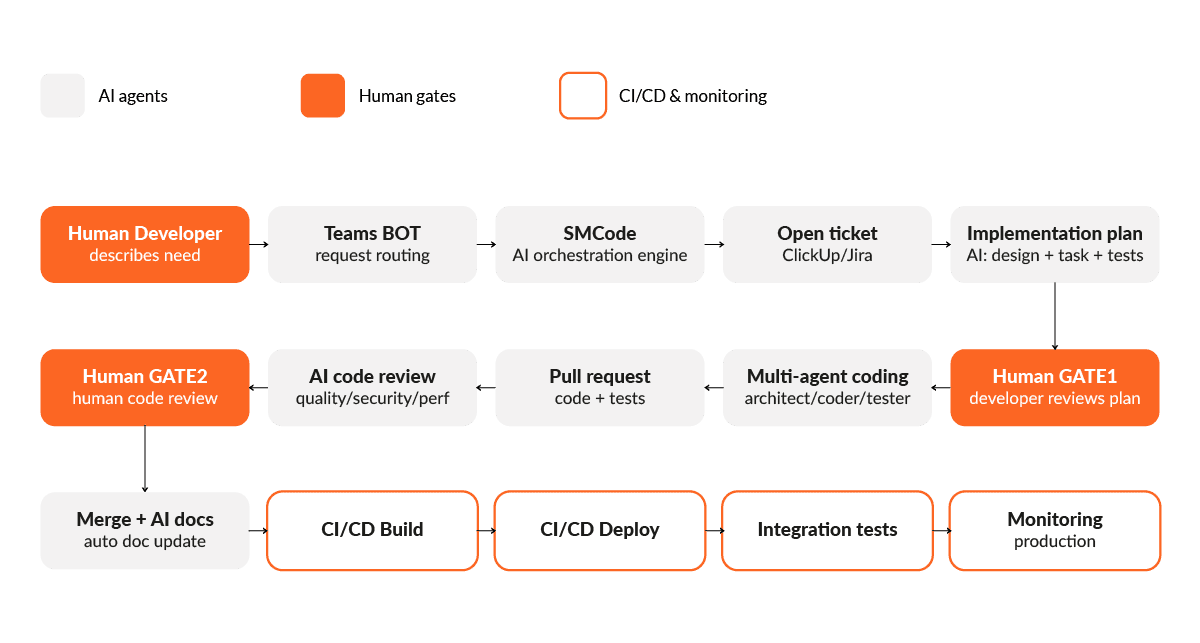
Human approval gates: Every implementation plan should be reviewed and approved by a developer before AI generates code. This structural control keeps auditors and regulators happy.
Quality gates: Security scans, dependency audits, automated compliance checks that AI can’t bypass. If a failure occurs, a merge is blocked.
Audit trails: Every AI action is logged, attributed and traceable, from prompt to commit to deploy. The goal is to achieve full transparency.
The orchestration layer
At a higher level of maturity, teams stop using AI only through one-off prompts. Instead they build repeatable workflows.
One agent may draft tests for changed files, one scans for security issues and another updates documentation after a release. This can work when the task is narrow and bounded. It gets dangerous the moment agents get vague goals and broad permissions. The machine should have a job description, not a blank check.
How AI-assisted delivery works:
Human-led, AI-driven support
The balance between human judgment and AI speed is the whole game. Human engineers oversee processes and maintain accountability, while AI agents generate 60-80% of code, tests, documentation and infrastructure.
Done right, an AI-powered SDLC cuts lead times, speeds up releases and raises code quality, all at lower cost. And the right AI SDLC runs in your environment, on your toolchain, end-to-end, with no rip-and-replace.
The measurable value our AI SDLC has delivered
60-70% reduction in idea-to-production time
5-10x more output, without expanding the headcount
100% automatic test coverage generation
100% audit trail of every AI action and human approval
Higher code quality
Full process observability
*Based on actual project data from Software Mind engagements
Want the deeper dive? The numbers, the guardrails and the real-world case studies are all in our latest ebook, Integrating AI into SDLC: Best Practice and Case Studies. Download your free copy
FAQ
What does “human-led, AI-driven” development actually mean?
It means AI generates the bulk of the work while people stay accountable for it. In practice, AI agents produce 60–80% of code, tests, documentation and infrastructure, but human engineers oversee the process, approve implementation plans and keep control of critical code. AI has the ability to automate, accelerate and optimize workflows, but should not run unsupervised. Keeping humans at the helm enables companies to leverage the speed of AI without giving up quality, governance or security.
How should a company start integrating AI into its SDLC?
Meaningful integration aims at the places that actually hurt: requirements that fail, weak tests, stalled reviews, drifting documentation and knowledge trapped in a couple of people’s heads. Before launching, teams need to define what repositories and systems AI can access, which data must stay in the environment, coding and architecture standards, mandatory review rules, security and compliance gates, quality and productivity metrics and escalation paths for risky output.
What is an AI Pod and how does it keep humans in control?
An AI Pod is a small, senior team that pairs human specialists with best-of-breed tools to accelerate the whole lifecycle without sacrificing quality, governance or security. Its size depends on the project, but the core roles stay fixed: an AI Pod Lead accountable for delivery, a Solutions Architect driving technical vision, an AI-Augmented Engineer orchestrating multiple AI agents in parallel, a QA Engineer validating all AI-generated testing, and a Platform Engineer scaling the platform and integrations. The pod follows a cycle: Plan, Generate, Review, Validate, Deploy, Learn. Humans stay in control of approval plans and critical code, and each cycle feeds a self-learning layer so AI accuracy improves over time.
What does a working AI SDLC setup require, and what results can it deliver?
Whatever the project, a working setup requires four layers: the tool layer (coding assistants, model APIs and integrations that support engineers directly), the context layer (approved internal knowledge fed in via RAG so AI works from the company’s real standards, not general training data), the governance layer (rules, approval gates, quality gates that AI can’t bypass, and full audit trails) and the orchestration layer (repeatable, narrowly-scoped workflows rather than one-off prompts).

About the authorDamian Mazurek
Chief Innovation Officer
A certified cloud architect and AI expert with over 15 years’ experience in the software industry, Damian has spent the last several years as a cloud and AI consultant. In his current role he oversees the technology strategy and operations, while working with clients to design and implement scalable and effective cloud solutions and AI tools. Damian’s cloud, data and machine learning expertise has enabled him to help numerous organizations leverage these technologies to improve operations and drive business growth.

About the authorMichael Greenberg
Chief Business Officer & Global Head of Commercial AI
A commercial leader with deep experience building and scaling technology, SaaS and service-based businesses. In his current role he leads Software Mind's commercial strategy while driving its global AI agenda. Michael champions a data-first, human-led approach to AI - treating it as an orchestration and enablement layer that helps organizations work faster, smarter and more efficiently.