



Table of contents:
Recognizing the symptoms of a struggling Transport Management System is easy – you see the daily firefighting, peak season crashes, integration deadlocks – you name it. But before making any major strategic decisions – whether that means a full system replacement, targeted modernization or the good old “wait and see” tactic – you need hard data. Not hunches or opinions. Facts.
The below step-by-step guide outlines the exact internal framework we deploy when auditing logistics companies’ tech stack. We are opening up our playbook so that you can run this diagnostic yourself and uncover exactly where your TMS is falling short. Check it out.
1. Measure real-world system performance
System speed directly dictates dispatcher efficiency. To move past subjective complaints like “the system feels slow today,” you need to look into exact performance metrics.
What to check:
Log into the system during peak hours (typically 8-10 a.m.) and measure:
- Main dispatcher dashboard load time
- Courier parcel list load time (>100 parcels)
- Daily report generation time
- New order import time
Where to look:
- Application server logs – look for timeout errors, slow queries, memory warnings
- Database monitoring – CPU usage, query execution time, lock waits
- Mobile app logs – crash reports, ANR (Application Not Responding)
Evaluate your findings against these benchmarks:
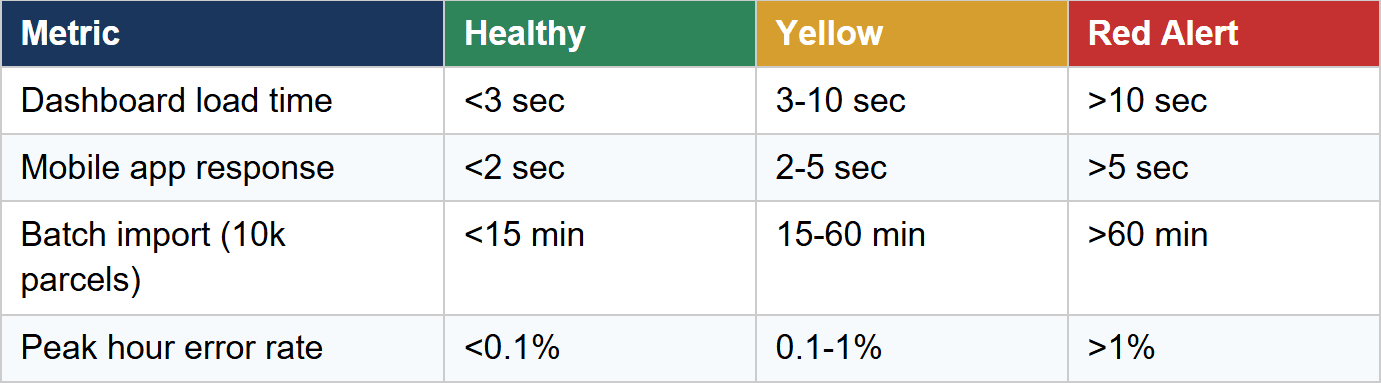
| Metric | Healthy | Yellow | Red alert |
|---|---|---|---|
| Dashboard load time | <3 sec | 3-10 sec | >10 sec |
| Mobile app response | <2 sec | 2-5 sec | <5 sec |
| Batch import (10k parcels) | <15 min | 15-60 min | 60 min |
| Peak hour error rate | <0.1 % | 0.1-1 % | >1 % |
A good practice to back up your data with internal context would be to take these benchmarks to your IT team and ask:
- When was the last serious performance incident?
- Do we have automated alerts for performance degradation and who receives them?
- What is our current infrastructure headroom (CPU/RAM usage) during peak volume spikes?
2. Map the data flow (the “spaghetti” test)
A scalable tech stack relies on clean, predictable data movement. To evaluate your architecture, trace the lifecycle of one parcel from initial order creation through to final delivery. Account for every single system it touches – including the TMS, Warehouse Management System (WMS), CRM, billing software, courier apps, customer portals and partner integrations. Gather your integration documentation, ETL jobs, middleware and synchronization scripts.
As you trace this journey, look closely at how many times the exact same information is manually entered or duplicated and where the technical gaps exist that allow data to fall out of sync.
Practical exercise
Draw your data flow map (yes, physically on paper or a whiteboard). Represent each distinct system as a rectangle and every integration path as an arrow. Next to each arrow, explicitly label the method: is it real-time or batch? Is it powered by an API or file transfers? Who owns the maintenance of that link?
The rule of thumb: If your final map resembles a tangled web of spaghetti, you have a problem with your data integrity.
Once you see how these systems connect on paper, take those insights to your technical and operations teams to address the hidden operational risks. Start by asking these three critical questions:
- Which system is the “source of truth” for parcel status?
- What happens when an integration goes down at 3 a.m.? Who gets alerted?
- How many integrations do we have that nobody fully understands?
3. Shadow your core operations
When it comes to the effectiveness of a logistics system, software metrics only tell half the story; user behavior tells the rest. This being said, spend a full shift sitting directly next to an experienced dispatcher. Observe their workflow without interrupting their routine.
What to watch for:
- System hopping: Count how many application windows, tools or browser tabs they must keep open simultaneously to complete a task.
- Human middleware: Watch for manual workarounds – such as copy-pasting data between systems or running side-calculations in spreadsheets because the TMS cannot automate the rule.
- Friction points: Document audible signs of frustration, repeated clicks or unexpected phone calls from couriers asking for data missing from their screens.
Helpful questions to ask the dispatcher:
- If you could change one thing in the system, what would it be?
- How much time daily do you lose on things the system should do automatically?
- What do you need to work faster?
- What do you do when the system goes down? What’s “Plan B”?
The operational efficiency metric
Divide a dispatcher’s daily time into three buckets:
- Strategic planning.
- Standard operations.
- Firefighting or exception handling.
If firefighting and manual exception handling consume more than 40% of their shift, the software is no longer supporting your operations – it is consuming your manual labor.
4. Ride with a courier
A flawless desktop experience matters little if the mobile application fails where deliveries actually happen. Spend half a day shadowing a courier on their route to see how the software performs under pressure. Note:
- How many clicks do they need for one delivery?
- How do they handle edge cases (customer not home, wrong address, damaged parcel)?
- Do they use the app as intended or do they have their own “hacks”?
- What do they do when the app doesn’t work or is offline?
Real-world field checklist
- Click debt: Count the exact number of screen taps required to successfully log a single standard delivery.
- App bypassing: Document if the courier bypasses the built-in tools – for example, manually typing delivery addresses into Google Maps or writing notes on paper because the app’s routing or messaging is clunky.
- Environmental constraints: Watch how the application behaves when cell service drops, such as in elevators, basements or underground parking garages. Does it handle offline data sync seamlessly or does it freeze?
5. Audit the knowledge
A stable logistics system is one that survives personnel changes. Identify the “critical knowledge holders” within your organization – the people without whom the system can’t function. It could be the developers, architects, vendor contacts, you name it.
Practical exercise
Map out the key areas of your TMS logic to see where your operational vulnerabilities lie. Creating a table like the one below could be helpful here:
| System area | Who understands? | Backup? | Documentation? |
|---|---|---|---|
| Core TMS logic | |||
| Partner integrations | |||
| Routing algorithm | |||
| Mobile app |
The risk: If any critical row shows a single name with no clear backup, your logistics business faces a significant “bus factor” problem, where the system logic is known only to a couple of crucial employees. Thus, with them gone, nobody will know the system.
6. Test the flexibility
In the logistics and courier market, your tech stack is either an accelerator or a roadblock. To test its true agility, run a quick simulation with your IT team or software vendor. Ask them how long it would realistically take to execute four realistic business scenarios:
- introducing a new delivery service tier, such as scheduled delivery windows and wiring it end-to-end across order capture, routing, tracking and reporting,
- integrating a new parcel locker network or PUDO partner,
- onboarding a new B2B client with their own custom rules – distinct SLAs, pricing structure and labeling requirements,
- adding a new customer notification channel, such as WhatsApp alongside your existing SMS and email – including templating, opt-in/consent handling and delivery-status callbacks.
Decoupling the feedback
The timelines provided by your technical teams offer a clear view of your current level of technical debt:
- Under a week: The system is flexible and well-designed.
- 1-2 months: You are dealing with standard tech debt. It is manageable, but it requires careful planning.
- A quarter or more: Serious architectural rigidity is present; the software slows down business agility.
- Requires a full rebuild or is deemed impossible: The software has officially crossed the line from a supportive tool into a strategic liability.
Additional check
As a final check, look at the project backlog and pull a list of feature requests that have been languishing for over a year. If the list is long and packed with critical capabilities your operations team desperately needs – it is a clear sign that your IT can’t keep up with the business.
7. Verify core data quality
To stress-test your Transport Management System’s data health, pull a random sample of 100 parcels processed over the past week and audit their journey across your entire ecosystem.
What to check:
- How many addresses are correctly geocoded?
- How many have complete contact data (phone, email)?
- How many have consistent status across all systems?
- How many have correct timestamps for each event?
Where to look:
- Address table – how many records don’t have GPS coordinates?
- Customer duplicates – how many customers exist under different name variants?
- Data quality reports (if they exist)
- Customer service – how many tickets are about bad data (wrong address, wrong phone)?
Simple test
For a final verification, generate the exact same operational report – such as your weekly delivery success rate – from two different platforms, like your TMS database and your customer billing software. If the final metrics do not match perfectly, you have a “single source of truth” problem that will completely undermine any future automation or scaling efforts.
Metrics you should know:
- Percentage of addresses with correct geocoding,
- Percentage of parcels with complete audit trail (every status, every timestamp),
- Average time from event to visibility in systems.
8. Measure your true scaling readiness
Conclude your TMS diagnostic with an honest math check of your growth trajectory. Compare your daily parcel volumes from two years ago against today’s throughput and then map those numbers against your projected volume for the next two years.
Every system has an invisible breaking point. If your projected volume exceeds 150% of the capacity your TMS architecture was originally designed to handle, you are on a collision course with operational failure. Legacy software cannot scale horizontally simply by adding more server power; structural changes become obligatory. If the math shows you are crossing that threshold, it is time to build a modernization plan before the system caps your business growth.
The verdict: interpreting your TMS diagnostics
All right, so you have completed this logistics architecture health check. Now what?
Now, you possess more objective, hard data about your Transport Management System than 90% of your competitors. That’s already an advantage. What’s next depends on what you have found. Once you compile these metrics, your logistics business will fall into one of three distinct scenarios:
Scenario A: “Better than I thought”
Your core architecture is structurally sound and the issues you uncovered are isolated. Rather than a large-scale, disruptive transformation, your focus should be on targeted, high-impact quick wins – such as improving the courier app UX, automating a single manual process or documenting critical areas.
Scenario B: “It’s bad, but I know where”
You have identified clear, manageable bottlenecks and know exactly which technical liabilities are critical. Your next step is to build a structured modernization roadmap. Prioritize what needs immediate fixing versus what can wait. Decide if your team has the capacity and know-how to do it alone or if you need to bring in some outside help.
Scenario C: “Worse than I thought”
The audit reveals systemic flaws deeply embedded in the architecture. Point fixes, patches and minor software updates will no longer suffice. You need a comprehensive modernization plan for your logistics system – but one that won’t paralyze ongoing daily operations. This is the moment to talk to someone who’s done it before.
What’s next?
If your diagnostic lands squarely in Scenario C – or if you hit complex questions along the way that your team couldn’t quite answer – we’re here to help. With our vast, hands-on experience in courier and logistics software development, we help businesses build and modernize high-performance supply chain ecosystems.
Let’s jump on a quick, zero-commitment call to look over your findings. We can share what we’ve seen work for other logistics operators and help you map out the fastest path to a scalable, flexible future. Contact our experts.
FAQ
How often should we run this TMS health check?
Aim for an annual audit. However, if you start seeing a sudden spike in delivery complaints, weird billing glitches or severe system slowdowns during peak season, run the diagnostic right away.
We found a mix of Scenario B and C. Where do we even start?
Always start with data integrity and security gaps first. If your data is corrupted or falling out of sync, fixing a user interface or adding a new feature won’t solve the underlying problems with your courier and logistics software.
Can we run this TMS diagnostic if we use a third-party SaaS vendor?
Definitely. You might now own the source code, but asking these questions reveals how well the vendor’s API handles your Transport Management System data and how quickly their support team responds to your business demands.
How long should it realistically take to complete this TMS health check?
If your Transport Management System documentation is up to date, a small cross-functional team of IT and operations leaders can track down these metrics and map the data flows in less than a week.

About the authorMichał Zgała
Software Delivery Manager
Michał leads projects that build enterprise-grade, bespoke logistics software for last-mile delivery companies. With 15 years of proven experience in project management, including four years in courier and logistics technology, he has managed the development of systems that power nearly half a billion package deliveries annually. His work includes courier applications, PUDO (pick-up/drop-off) point management systems, parcel locker network integrations and transportation management systems.